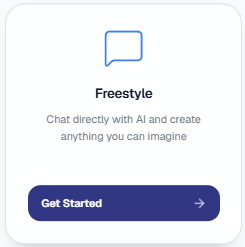
The "Free Style Chat" feature within Marketr is your direct interface with advanced AI marketing and sales intelligence. It's designed to provide on-demand, tailored strategic guidance, content generation, and problem-solving for any marketing or sales challenge you face. Think of it as having a team of top-tier strategists available instantly, ready to execute your requests.
Purpose and Core Value
Marketr Free Style Chat empowers you to bypass predefined templates and directly articulate your marketing and sales needs in natural language. Its core value lies in its flexibility and ability to generate highly customized, context-aware outputs, from complex strategy outlines to compelling copy, all in real-time. This accelerates your workflow, enhances decision-making, and delivers actionable assets precisely when you need them.
How to Leverage Free Style Chat: A Step-by-Step Guide
Clearly Define Your Objective: Before typing, articulate what you want to achieve. Are you seeking a new email sequence, a strategic plan for a product launch, a persuasive headline, or an analysis of a market segment?
Example: "I need a 5-day email sequence to nurture leads for my online course on advanced photography."
Provide Context and Specifics: The more information you provide, the more tailored and effective the AI's response will be. Include details about your audience, product, desired tone, specific challenges, or any constraints.
Example: "My audience is aspiring professional photographers, 25-45, struggling with client acquisition. The course is high-ticket ($997). I want the tone to be authoritative yet encouraging, focusing on transformation. Mention a limited-time bonus for early enrollees."
Specify Output Format (Optional but Recommended): If you have a preferred structure or format for the output, state it. This could be bullet points, a numbered list, a specific word count, or a particular document type.
Example: "Please provide the email sequence with subject lines, email body, and a clear call to action for each day, formatted in markdown."
Iterate and Refine: The first response is a starting point. Don't hesitate to ask for revisions, elaborations, or alternative approaches. Use follow-up prompts to refine the output until it perfectly matches your needs.
Example (follow-up): "Can you make the subject line for Day 3 more benefit-driven, perhaps focusing on the 'client acquisition' pain point? Also, add a testimonial snippet to Day 4."
Request Image Generation (When Applicable): If your request involves visual content, clearly state your image needs. Describe the subject, style, mood, and any specific elements you want included.
Example: "Generate an image for a social media ad promoting the photography course. It should feature a professional-looking photographer successfully interacting with a client, in a modern, clean style, with a confident and inspiring mood."
Chat Hygiene: Optimizing for Performance and Efficiency
While Marketr's AI can process significant amounts of information, practicing good "chat hygiene" is crucial for optimal performance, faster responses, and efficient token usage. Providing excessive, unnecessary information can slow down the system and lead to incomplete or less focused outputs.
Avoid Information Overload: Only provide the essential information required for the AI to complete the current task. For instance, if you're asking for feedback on a course structure, there's no need to include the full script of every module. The AI primarily needs the module titles and descriptions to assess the overall flow and uniqueness.
Understand Processing Limits and Tokens: Every interaction consumes a "processing budget" (tokens). The more information you feed into a single chat, the more tokens are used. When this budget is exceeded, the AI may stop processing and provide an incomplete response. Remember that in an ongoing chat, the entire conversation history is sent with each new prompt, rapidly increasing token consumption.
Break Down Complex Projects: For large, multi-part tasks (like reviewing an entire course or writing a series of articles), break them into smaller, manageable chunks.
- Phase 1: Structure First. Begin by focusing solely on the high-level structure. For a course, provide only the introduction and module titles/sub-topics for review.
- Phase 2: Module by Module. Once the structure is approved, work on individual sections or modules separately.
Implement the "Summarize and Start New Chat" Strategy: This is a powerful technique for sequential content creation:
- Step A: Complete a Section. Work on a specific module or section in a dedicated chat until you are satisfied with the output.
- Step B: Request a Summary. Ask Marketr to provide a concise summary of the completed section.
- Step C: Start a New Chat. Begin a completely new Free Style Chat.
- Step D: Provide Context + New Content. In this new chat, provide the summary of the previous section(s) and then introduce the details for the next section you want to work on.
- Example: When moving from Module 1 to Module 2, ask Marketr to summarize Module 1. Then, start a new chat, provide the Module 1 summary, and present the content/requirements for Module 2.
- This prevents the AI from having to re-process the full content of all preceding modules, saving tokens and improving response speed.
Focus on Relevant Context: The AI doesn't need every single word of your entire project to perform a specific task. For example, when asking for a sales page, a high-level overview of the course's benefits and target audience is more valuable than the full curriculum details. Tailor the context to the immediate goal.
Best Practices for Optimal Results
Be Specific, Not Vague: Instead of "Write some ad copy," try "Write three short Facebook ad variations targeting small business owners for my new CRM software, focusing on time-saving benefits."
Use Role-Playing: Frame your prompt by asking the AI to act as a specific persona. Example: "As a seasoned direct-response copywriter, craft a sales page headline for..."
Break Down Complex Tasks: For very intricate requests, consider breaking them into smaller, manageable prompts. You can always refer back to previous outputs in subsequent prompts.
Leverage Your Data: If you have customer testimonials, data points, or unique selling propositions, feed them into the chat for more personalized outputs.
Experiment: Don't be afraid to try different phrasing or approaches. The AI learns from your interactions.
Pro Tip: Marketr Free Style Chat thrives on clear, efficient instructions. The more precisely and judiciously you communicate your vision and requirements, the more accurately and effectively it can fulfill your request, acting as a true extension of your marketing and sales team.
Was this article helpful?
That’s Great!
Thank you for your feedback
Sorry! We couldn't be helpful
Thank you for your feedback
Feedback sent
We appreciate your effort and will try to fix the article